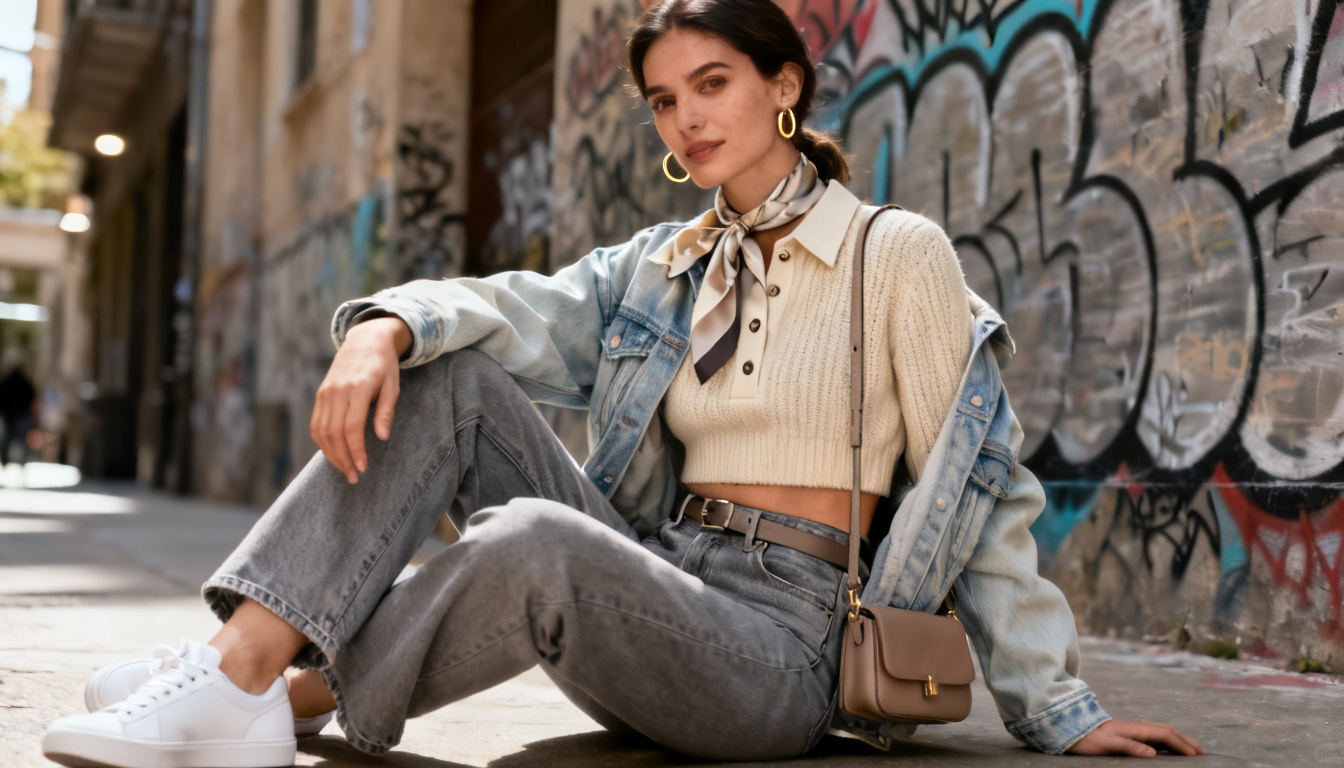
I’ve been watching this shift happen for the last two years, and 2026 feels like the year the basic outfit finally got its due respect. We’re past the era of logos screaming for attention, and we’ve moved through the quiet luxury phase where everyone just wore beige cashmere. Now, we’re in a space where the most photographed people on the planet are walking around in what looks like your weekend errands uniform but somehow, they look like they just stepped off a runway.
It’s not magic. It’s a very deliberate set of choices that most of us miss because we’re looking at the wrong things. Let me break down what’s actually happening.
The Real Secret Isn’t the Clothes It’s the Silhouette Shift
If you watch how Zendaya or Timotheus Calame stepped out in early 2026, you’ll notice something strange: the outfits are simpler than they’ve been in years. A plain white t-shirt. Straight-leg jeans. No patterns. But the fit is completely wrong for a normal person’s body and that’s the point.
What I’ve observed is that celebrities are now treating basic pieces like blank canvases for extreme tailoring. That white tee isn’t off the rack from Uniqlo. It’s been taken in at the sides by three inches, the shoulder seam has been dropped slightly, and the sleeves have been hemmed to hit exactly at mid-bicep. The jeans aren’t just straight they’re cut with a slight taper that creates a perfect break over a specific shoe.
The 2026 rule seems to be: if you’re wearing a basic, it must be altered to within an inch of its life. I spoke with a stylist friend who works with a few A-listers, and she told me that every single piece in a simple outfit gets at least two fittings. That’s the real work nobody sees.
Texture Is the New Logo
In 2025, everyone was obsessed with fabric quality. In 2026, the game has moved to texture contrast. I noticed this first on Ayo Edebiri at a premiere after-party. She wore a cream silk cami, matte black trousers, and a raw-edged wool blazer. Three pieces. All neutral. But the silk, the matte fabric, and the rough wool created a visual tension that was far more interesting than any pattern could be.
The trick is to avoid matching textures. If you’re wearing a ribbed cotton tank, don’t pair it with ribbed trousers. Put it under a slick, almost plastic-like vinyl jacket. The friction between textures reads as intentional and expensive. I’ve started doing this myself wearing a brushed flannel over a glossy nylon shell and people have asked if I’m wearing designer. I’m not. It’s just texture play.
The Accessory Bible Has Been Rewritten
Forget the statement necklace. In 2026, it’s all about the one weird accessory that breaks the monotony. I’m talking about a single, oversized sculptural ring on the middle finger. Or a pair of sunglasses that are just slightly too small for the face. Or and this is the big one a bag that makes no sense with the outfit.
I saw Hailey Bieber in a photo from February wearing a boxy grey sweatsuit with a tiny, beaded bag shaped like a grapefruit. It was absurd. It shouldn’t have worked. But it did, because the bag was the only thing your eye could focus on. That’s the strategy: one absurd element, and everything else stays dead simple.
There’s also been a massive shift toward legwear. Not just shoes, but the space between the hem of the pant and the top of the shoe. Celebrities in 2026 are obsessed with that sliver of skin or sock. They’re wearing sheer black stockings under cropped trousers with loafers, or chunky wool socks pulled up just enough to show two inches of calf. It sounds small, but it changes the entire proportion of a basic outfit.
The Case Study: How a $50 T-Shirt Looks Like $500
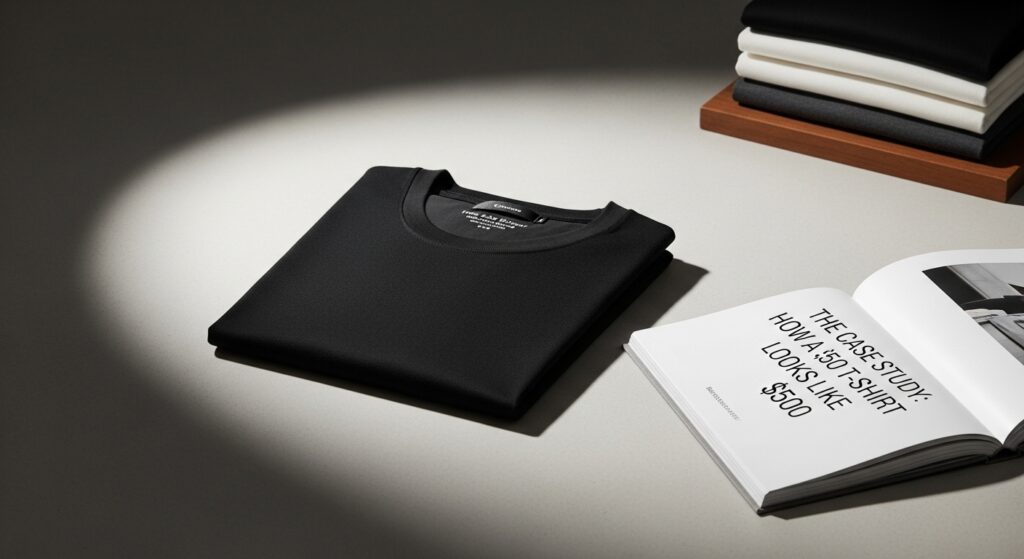
Let me walk you through a real example I saw on someone I won’t name (but you’d know). She was photographed grabbing coffee in a plain grey crewneck sweatshirt, dark wash denim, and white sneakers. On paper, it’s a uniform that exists in every mall in America.But look closer. The sweatshirt had a slightly dropped shoulder and a cropped hem that hit exactly at her hipbone, not below it. The jeans were a specific 1990s-inspired wide leg with a high rise, but they were hemmed to show exactly one inch of white sock above the sneaker.
The sneakers weren’t new they were visibly scuffed at the toe. That scuff was intentional. It signaled that this wasn’t a costume. It was a lived-in outfit.The lesson is that perfection in basics comes from controlled imperfection. Too crisp, and it looks like you’re trying. Too sloppy, and it looks like you gave up. The sweet spot is what I call polished neglect.
The “Third Piece” Rule Is Still King, But It’s Evolved
For years, stylists have said you need a third piece a jacket, a vest, a scarf to elevate a two-piece outfit. In 2026, that third piece has become something unexpected. I’m seeing a lot of unbuttoned, oversized denim shirts worn as jackets over tank tops. I’m seeing blazers that are clearly too big for the person wearing them, but they’re pushed up to the elbow with the sleeves rolled.
The best example I’ve seen was Timothée Chalamet at a screening: white t-shirt, black trousers, and a bright orange, extremely thin nylon windbreaker that looked like it was from a 1990s hiking brand. It wasn’t cold. He wasn’t going hiking. The jacket existed purely to add a block of color that broke the monochrome.
A Word on Ethics and Accessibility
I need to be honest about something. This look is expensive to achieve, even when the pieces are basic. The tailoring alone can cost more than the garment. The accessories that make the outfit work are often vintage or limited edition. And the styling knowing exactly how to break the rules comes from years of experimentation and access to professionals.
But I’ve found that the principles translate even on a budget. I own a $12 white t-shirt that I had a local tailor take in for $15. I thrifted a vintage windbreaker for $8. The sculptural ring? It’s from an independent maker on Etsy for $30. The key is patience and looking at your wardrobe with a critical eye. Ask yourself: is this basic actually basic, or is it just boring? The difference is in the details.
The Bottom Line
Celebrities in 2026 aren’t showing us what to buy. They’re showing us how to see. The most stylish people right now are the ones who can make a white t-shirt and jeans look like a statement. That takes more thought, not less. It’s about proportion, texture, and one weird piece that makes people stop and wonder. Next time you’re putting on a plain outfit, ask yourself: what’s the one thing I can change that will make someone look twice? That’s the 2026 way.
FAQs
Q: How can I make a basic t-shirt look expensive without tailoring it?
A: Focus on fit first. Size up for a relaxed look, or size down for a fitted silhouette but avoid baggy and tight at the same time. Tuck it loosely into high-waisted trousers, or tie a knot at the hem. Then add a textured jacket or a single bold accessory to draw attention away from the tee itself.
Q: What’s the one accessory that works for everyone in 2026?
A: A chunky, unpolished leather belt. Not a designer logo belt, but a thick, matte leather belt with a simple brass buckle. It breaks up the torso, adds weight to lightweight fabrics, and works with jeans, trousers, or over a blazer.
Q: Are sneakers still acceptable for a basic outfit in 2026?
A: Absolutely, but the trend has shifted toward slightly chunky, retro-inspired sneakers in off-white or beige. Avoid pure white they look too intentional. Scuffed or slightly worn sneakers signal effortlessness.
Q: How important is fabric quality if I’m on a budget?
A: Very, but you can cheat. Look for high cotton thread count in thrifted pieces it feels better than most new fast fashion. Also, avoid polyester blends for basics. A 100% cotton tee from a secondhand store will always look better than a brand-new synthetic one.
Q: Can I pull off the “one weird accessory” trend if I dress conservatively?
A: Yes. The weird accessory doesn’t have to be loud. It can be a subtle detail like a pair of gloves in an unexpected color, a brooch in an unusual shape, or a bag with an interesting closure. The point is contrast, not chaos.
