
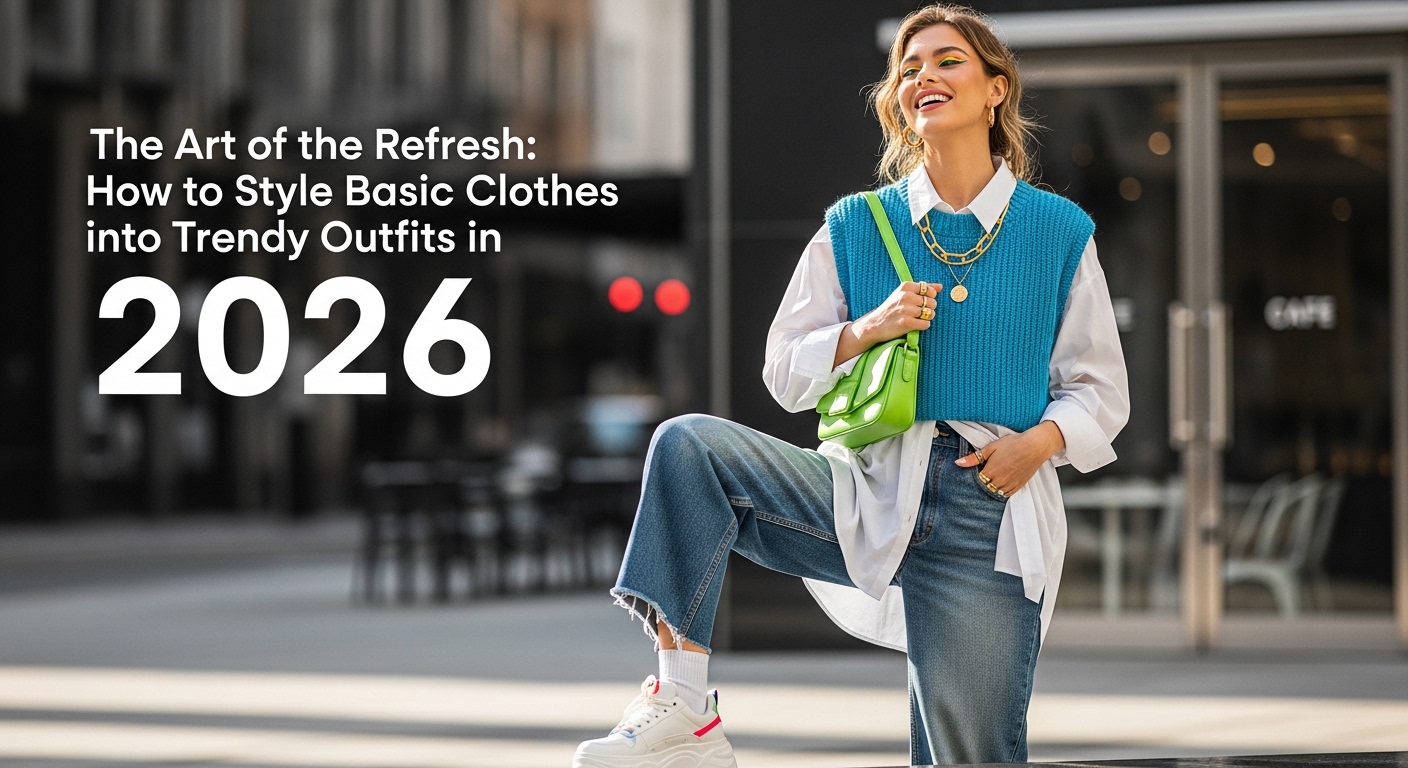
Open your closet. What do you see? If you’re like most of the clients I’ve worked with over the past decade, it’s probably a sea of neutrals. A white tee here, a pair of straight-leg jeans there, a black blazer hanging lonely in the corner. We’ve been told for years to invest in capsule wardrobes and timeless essentials. And honestly? That advice wasn’t wrong. But by 2026, wearing basics exactly as they are feels a bit… flat.
The fashion landscape has shifted. We’re past the peak of quiet luxury and moving into what I call expressive minimalism. It’s not about buying the next viral item from a fast-fashion haul; it’s about taking what you already own and twisting it until it feels new. I’ve spent the last few seasons helping people navigate this exact transition. The goal isn’t to chase every micro-trend but to use 2026’s styling language to breathe life into those trusty staples. Here’s how I’m seeing it done right now, without spending a fortune or contributing to the textile waste crisis.
The Proportion Play
If you take one thing away from this, let it be this: silhouette is everything. In 2024, we were obsessed with baggy everything. By 2026, the pendulum has swung toward balance. It’s about tension. Take that oversized white button-down you’ve had since college. Instead of wearing it loose over jeans, try cinching it. I recently worked with a client, let’s call her Elena, who felt stuck in a rut of mom jeans and a tee. We took her oversized shirt, tucked it tightly into a slim, midi-length skirt, and added a structured belt over the shirt itself. Suddenly, the basic shirt wasn’t just a shirt; it was a blouse with intention.
The rule of thumb I use is simple: if the top is voluminous, keep the bottom streamlined, and vice versa. A boxy basic tee looks infinitely more trendy when paired with a flowing, maxi-width trouser that grazes the floor. It elongates the leg and makes the outfit feel curated rather than thrown on.
Texture is the New Color
For a long time, we relied on prints to make statements. But looking at the street style scenes from Copenhagen to New York this year, texture is doing the heavy lifting. When you’re working with basic colors like black, white, or beige, the fabric difference is what creates visual interest.
Think about mixing a ribbed cotton tank with a sleek, faux-leather trench. Or pairing a soft cashmere sweater with rough, raw-denim jeans. I love throwing a chunky, knitted vest over a plain silk slip dress. It creates a juxtaposition that feels high-effort but is actually incredibly easy.
In 2026, sustainability is non-negotiable, and texture is a great way to honor that. You don’t need new clothes; you need different feelings clothes. Dig out that wool scarf you never wear and drape it over your shoulders like a shawl over a simple t-shirt. The shift in material signals to the eye that this is an outfit, not just laundry day.
The Accessory Evolution
Here’s where the “2026” part really kicks in. Accessories have gotten bolder, but also more functional. We’re seeing a move away from delicate gold chains toward statement pieces that look almost architectural.
A basic black dress is nothing without the right hardware. I’m talking about chunky silver cuffs or layered necklaces that sit high on the collarbone. But it’s not just jewelry. Footwear has changed the game. A plain pair of jeans and a white tee can look dated with standard sneakers. Swap them for a loafers with a exaggerated sole or a boot with a unique heel shape.
I remember styling a photoshoot last month where the model wore a standard grey sweatshirt. It looked boring until we added a wide, structured leather belt bag worn across the chest and some retro-futuristic sunglasses. Suddenly, the sweatshirt felt like part of a uniform rather than loungewear. It’s about anchoring the basic piece with something that demands attention.
Color Doping Neutrals
You don’t have to abandon neutrals to be trendy. In fact, earth tones are holding strong. But the trick in 2026 is “color doping.” This means adding a singular, high-voltage accent to a muted base.
If your outfit is all beige and cream, introduce one item in a digital lavender or a deep, acidic green. It doesn’t have to be a whole garment. It could be a bag, a pair of socks peeking out over boots, or even nail art that complements the look. I’ve found that people hesitate to wear bright colors near their face, but wearing them below the waist or as an accessory removes that barrier.
One of my favorite combinations this season is a charcoal grey suit worn with a bright orange knit underneath. It’s professional enough for a meeting but sharp enough for dinner. It breaks the monotony of the basic suit without requiring a whole new wardrobe.
The Reality Check: Limitations and Ethics
I need to be real with you. Not every trend works on every body, and not every styling hack is practical for your life. I’ve tried the pants over pants layering trend, and unless I’m walking a runway, it’s just uncomfortable. Styling should enhance your life, not complicate it.
Also, we have to talk about the ethical side. The most trendy thing you can do in 2026 is wear what you already own. The pressure to constantly refresh your look is often driven by algorithms pushing new products. Resist that. When you style a basic piece in a new way, you’re extending its lifecycle. That’s better for your wallet and the planet.
There’s a limitation to this approach, though. Sometimes, a basic item is just too worn out. No amount of belting or layering will fix a t-shirt that has lost its structure. Know when to retire a piece. Sustainability isn’t about hoarding clothes you don’t wear; it’s about valuing the ones you do.
Putting It Together
So, how do you start tomorrow morning? Pick one basic item. Maybe it’s your go-to denim jacket. Lay it out. Now, ask yourself: How can I change the proportion? Can I layer it over a dress instead of under it? How can I change the texture? Can I add a silk scarf to the collar? What accessory makes this pop?
Fashion in 2026 isn’t about having the right things; it’s about having the right perspective. It’s about looking at that plain white tee and seeing a canvas instead of a default. I’ve seen women transform their confidence just by tweaking how they tuck in their shirt. It sounds small, but when you look in the mirror and see something intentional, you walk differently.
Don’t worry about being perfectly on-trend. Trends are fleeting. Style is what remains when you take the basics you love and make them speak your language. Go dig through that closet. You’d be surprised at what you find when you stop looking for clothes and start looking for possibilities.
FAQs
Q: Can I make basic clothes look trendy without buying new accessories?
A: Absolutely. Try changing how you wear existing items. Tuck shirts differently, roll up sleeves to change proportions, or layer pieces you usually wear separately.
Q: Is sustainable fashion actually trendy in 2026?
A: Yes, wearing vintage or restyled clothes is considered highly stylish. The focus has shifted from “new” to “unique” and “long-lasting.”
Q: What is the biggest styling mistake people make with basics?
A: Wearing everything the same fit. If your top is loose, wear fitted bottoms. Matching oversized tops with oversized bottoms can often look sloppy rather than stylish.
Q: How do I know when a basic item is too old to style?
A: Check the structure. If the fabric is thin, pilled excessively, or the seams are stretching out, it’s time to recycle it. Styling can’t fix poor condition.
Q: What color trends work best with neutral basics?
A: In 2026, high-contrast accents work best. Think electric blue, vibrant orange, or deep emerald green against black, white, or grey bases.
